AI readiness audit, scored in five minutes.
An AI readiness audit tells you whether your company can absorb AI before you spend on it, and this one scores you in five minutes. 22 questions, weighted the way adoption actually works: 30% data and technology, 70% people and process. Your score shows up on the spot.
Stop paying smart people to do dumb work.
About five minutes. You get a score, your weakest pillar named, and a recommended next step, on screen.
or press Enter
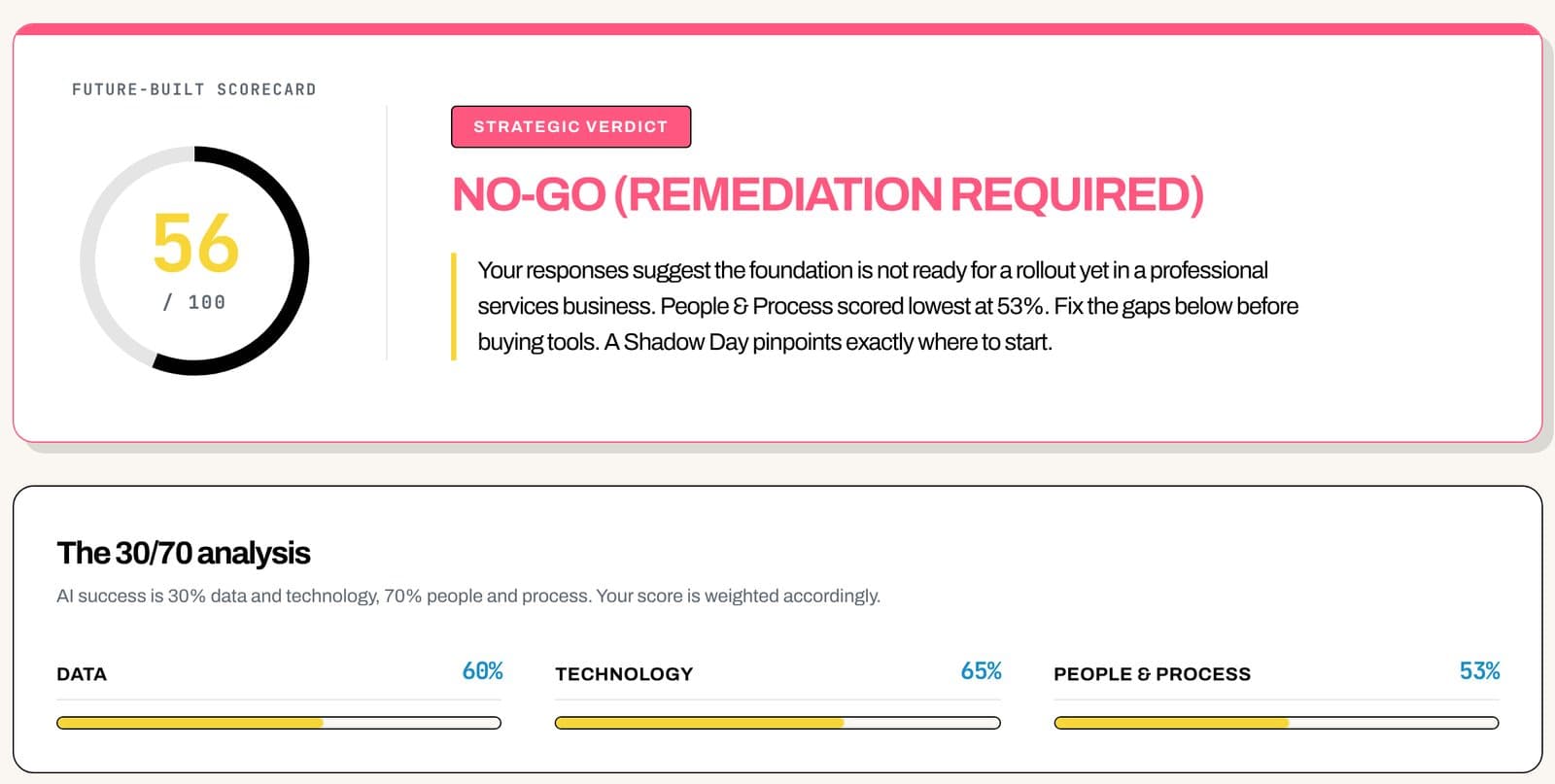
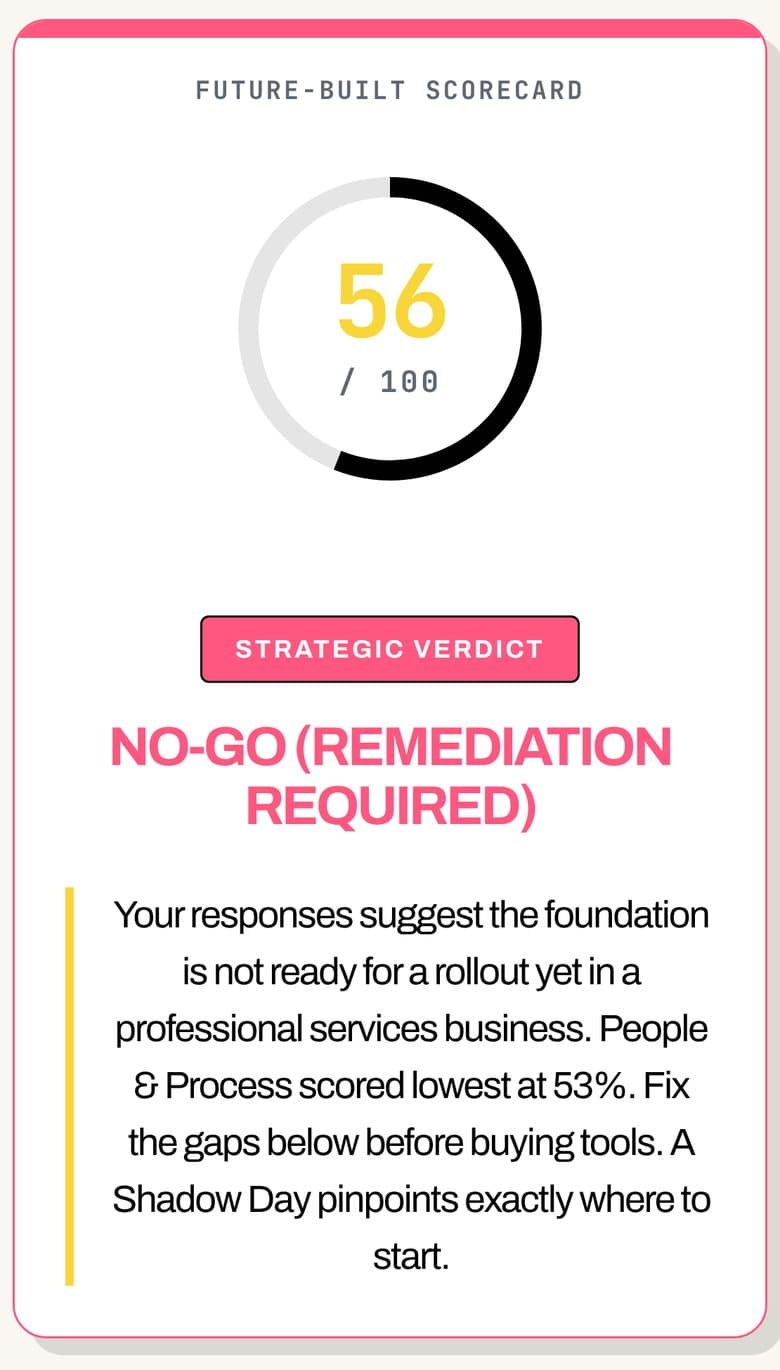
What the report looks like when you finish. This one is a made-up professional services firm with 51 to 200 people. It scored 56, with people and process lowest at 53%.
What an AI readiness audit measures
An AI readiness audit measures three things: technical readiness, organizational readiness, and cultural readiness. Together they decide whether AI adoption sticks:
- Technical readiness. Your data and your tooling. Worth 30% of the score, because the technology is the easy part.
- Organizational readiness. How decisions get made, whether anyone owns AI outcomes, and whether your processes are documented. The first half of the 70%.
- Cultural readiness. Will your team use what you roll out? Trust, incentives, change appetite. Most AI audits skip this part. It's also the most common reason pilots die.
Your score shows up on screen the moment you finish, with the gaps ranked by impact and a clear read on what to fix first.
Why this AI readiness audit weights people and process at 70%
AI adoption fails on people and process far more often than on technology, so this audit weights people and process at 70% and data and technology at 30%. Most AI audits are tech inventories. Count the tools, score the data stack, hand you a maturity grade. Then the pilot fails anyway, because the failure point was never the technology. We see the same pattern in every engagement, and BCG found it in a survey of 1,000 executives: about 70% of AI implementation problems come from people and process, 20% from technology, and 10% from the algorithms. So that's how we weight the score.
- Data10%
- Technology20%
- People and process70%
Built by Ryan Mark, Principal & Founder at winship labs. The 22 questions come from conversations with 450 business owners and executive leaders in our workshops, audits, and projects. Questions last revised June 2026.
AI readiness audit vs AI maturity assessment
An AI readiness audit checks whether you can start; an AI maturity assessment scores how far along you already are. This tool does both, then does the part neither usually does: it ranks what to fix first. That is why the score is a readiness score and not a grade.
Who this AI readiness audit is for
This AI readiness audit is built for leadership teams that have bought AI licenses and are not seeing adoption, and for anyone sizing a first AI project before funding it. If your people already use AI on their own and nobody owns the result, start here.
What to do with your score
Scored low? You just saved yourself a failed pilot. Fix the foundations the report names before you buy anything. A mid-range score means you have specific gaps, and the report ranks them, so start at the top. High score? You're ready. Your constraint now is picking the right first workflow, not preparing.
Whatever you scored, the next step is the same. The AI Assessment (our Shadow Day) is the human version of this audit: we spend a day inside your real workflows and turn your score into a ranked, specific opportunity map. The audit tells you where you stand. The assessment tells you what to do about it. You can also size what the manual work is costing you, or see how our AI strategy consulting runs from there.
FAQ
What is an AI audit?
An AI audit is a structured read on where your company actually stands with AI, across technology, process, and people. This one is free and self-serve: 22 questions, about five minutes, scored on the spot.
Is this AI audit really free?
Yes. Your score and full report show up on screen the moment you finish. There's no sales call between you and your results.
What does the score mean?
It's 0 to 100, weighted 30% data and technology, 70% people and process. That's the ratio at which AI adoption actually succeeds or fails, so it's the ratio we grade on.
Is this an AI readiness assessment or a maturity assessment?
Both, honestly. As an AI readiness assessment it checks the concrete prerequisites; as a maturity grade it scores where you stand; then it ranks what to fix first, which neither usually does.
How long does an AI readiness audit take?
This AI readiness audit takes about five minutes: 22 multiple-choice questions, scored the moment you finish. A paid assessment by observation, the Shadow Day, takes one working day.
Do we need an AI readiness audit before an AI policy?
Yes. An AI readiness audit shows you what your people already do with AI and where the process actually breaks, which is what a policy has to cover. A policy written before the audit tends to ban the workarounds instead of replacing them.
How many people in our company are using AI without telling us?
More than you think, and the audit's organizational and cultural questions are built to surface that. Unsanctioned use is not the problem. It is the best data you have on where the work hurts, and the fix is a sanctioned path that is easier than the workaround.
What should we do if our score is low?
Don't buy tools yet. Fix the gaps the report names, in the order it names them. If you want help sequencing the work, the AI Assessment (our Shadow Day) turns the report into a specific plan.